Rewind · Ep 01
The Spade Bit
Which Newton's law hits this hand?
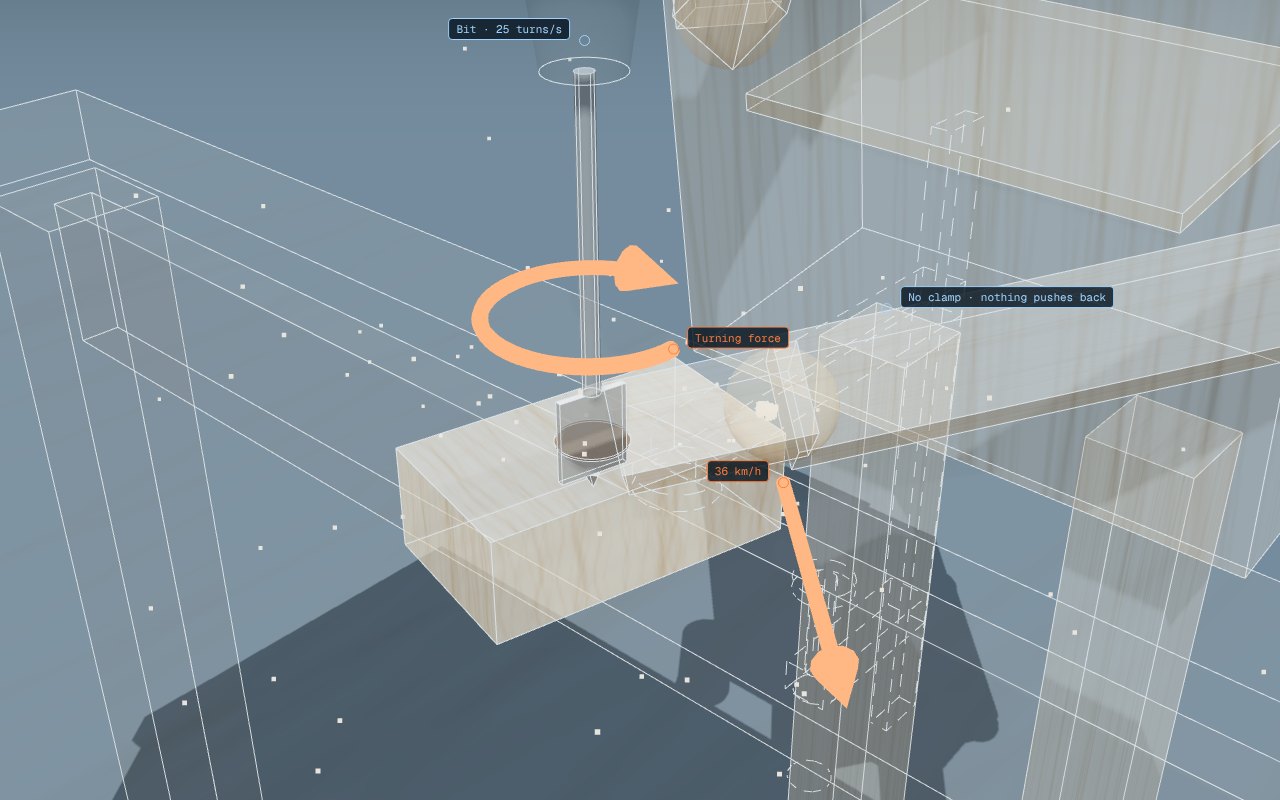
Drag to look around. Use “Try it” to switch the safety on and off and pull the trigger yourself.
What happens
A spade bit grabs a small block that nobody clamped. At real speed you can't see it happen. Slowed down about 240 times, you can watch the drill turn the block into the hand that was holding it, 13 ms after the bit bites. Then the same cut with one clamp, where nothing happens.
The rule
Clamp it. Then drill.
Fix small work to the bench with a clamp or a vice before you drill it. Keep both hands on the drill and none on the wood.
Your turn
Which of Newton's laws explains why the block hits the hand?
The answer: 2nd law.
The 2nd law: a force with nothing pushing back makes things speed up (F = m × a). The block is light and the drill is strong, so it speeds up very fast. The 3rd law is in the story too: it is why the drill twists in your hand when the bit jams in something that can't move.
The physics
Newton's 2nd law
F = m × a
When the bit grips the wood, the drill's turning force passes into the block. With no clamp, nothing pushes back, so the block speeds up. A clamp pushes back with the same force, the forces balance and the block stays still.
Moment by moment
How fast it happens.
- 0 msThe bit bites
The spade bit stops cutting and grips the wood. Now the drill is turning the block.
- 6 msFull speed
The block is turning as fast as the drill: 25 turns a second at 1,500 rpm.
- 13 msContact
The corner of the block reaches the hand at about 36 km/h.
- 200 msYou notice
A person takes about 200 ms to react to something they see. It was over long before that.
At the bench
Do this, not that.
Do
- Clamp small pieces to the bench, or hold them in a vice.
- Keep both hands on the drill.
- Let the bit reach full speed before it touches the wood.
- Press gently and lift the bit out now and then to clear the chips.
- Wear safety glasses.
Don’t
- Don't hold a small piece in your hand while you drill it.
- Don't push hard to make it cut faster.
- Don't wear gloves or loose sleeves near a turning bit.
- Don't pick the work up until the bit has stopped.
The numbers
What the model says.
From a simple model, not a measurement: a 110 × 63 × 38 mm softwood block (about 0.12 kg), a turning force of 4 N·m once the bit grips, and a drill at 1,500 rpm. Real drills, bits and timber vary.
| Bite to contact | 13 ms |
|---|---|
| Corner speed at contact | 36 km/h |
| Block spin at full speed | 25 turns a second |
| Typical reaction time | about 200 ms |
Put it into practice